
The Circle of We

Updated: Jun 3

Photo Credit: AI Powered by Dall E 3
“Did you know that if you put 100 black ants and 100 red ants in a jar, nothing will happen? But if you shake the jar hard, the ants start killing each other. The red ants consider the black ants their enemies, and the black ants consider the red ants their enemies. The true enemy is the one shaking the jar. The same thing happens in human society. So, before we attack each other, we should think about who is shaking the jar!”
-Modern Fable, often falsely attributed to Kurt Vonnegut
——————————————————
There have always been “red ants and black ants,” but now someone is shaking the jar hard! Maybe it’s the media; capturing eyeballs is the media’s business model. But that’s a cop-out.
It strikes me that much of the division we are experiencing in our country rests on the answer to a simple question: How broad is our personal circle of “We?” How many close friends do we have with political or religious viewpoints opposing our own?
“Birds of a feather flock together,” but, isn’t that part of the problem?
My Dad and I held opposing political views, and yet we didn’t avoid the subject. Instead, we tried to understand one another rather than prove each other wrong.
“We” defines affiliation. The broader our associations, the larger our circle of We. Affiliation can arise from many factors, including co-workers, hometowns, a geographic region, a parish, an alma mater, an interest, cultural or racial backgrounds, and, of course, political views.
The catalysts for affiliations are vast, but the acid test is how one defines us versus them.
Most people will go out of their way to help people inside their circle. Outsiders are on their own.
We’re naturally wary of people who differ from us; that’s a survival mechanism. The surest way to break the ice when meeting someone different is to find common ground, like a shared interest or hobby that establishes a foundation for We.
The breadth of our We defines our behaviors. If a friend is short a few bucks in the checkout line, we’ll top them up. If a street person asks for help, we might keep walking.
Who is in and who is out says more about us than it does about them. Where do we draw the boundary, and why?
When we disagree, most of us go into fight-or-flight mode. We either walk away, change the subject, or dig in our heels. Such approaches fail to advance understanding.
When I disagree with someone, I usually ask non-leading questions, like, “Why do you say that, or what do you mean?” If I can stay neutral, I learn about the person and the subject in question without jeopardizing We.
Once in a while, I’ll even change my mind.
I used to oversee contract negotiations for a large corporation. Over the years, I found that baseline values can differ, but as long as We is maintained, productive discussion continues. Alternatively, when We is violated, the conversation ends, and the negotiation reverts to a naked power struggle.
When facing someone outside our circle, it’s beneficial to step back and ask, “How am I defining We?” Do our differences outweigh the value of our relationship? It’s an important question to ask because people don’t often change their opinions.
There are no easy answers to these questions, but context is critical. I found in negotiations that it was almost always better to acknowledge and accept differences and then search for common ground rather than breaking off the discussion and going our separate ways.
I suspect that is true for our country as well, regardless of who is shaking the jar.
—————————————————————
If you enjoy my posts, please share them with a friend. Previous posts can be found here by subject category, and here chronologically. You can subscribe to my latest posts by filling in your email address at the bottom of this page.
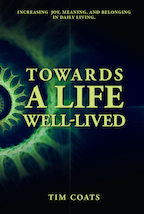
Towards A Life Well-Lived, is now a book.
To purchase a copy, please click this link
Proceeds donated to support individuals suffering with anxiety and/or depression.


Comments